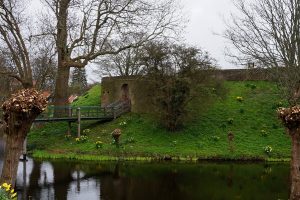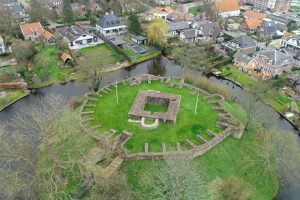
Originally, a wooden castle stood on the site of the Burcht in 636, likely built by the Batavians and/or Vikings.
The shape of both the former and current Burcht is reminiscent of refuge fortress found upstream along the Meuse and Rhine rivers at that time
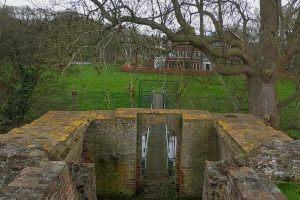
Construction of the current Burcht began in the early 12th century, making it one of the oldest in the Netherlands. The first step was the construction of a keep on the motte. Later, the wooden palisade was gradually replaced by a wall. This ring wall included a rampart walkway, built on barrel vaults and accessible via a few steps on either side of the wall.
From the 13th century onward, the Lords of Voorne, who had commissioned its construction, took possession of the keep. After the walls were completed, construction began on the forecourt on what we now call the Hofweide. The Hoflaan (courtyard) provides a good representation of the forecourt’s outline.
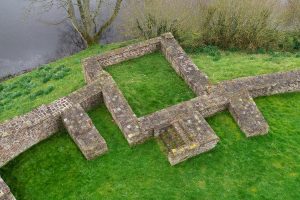
A variety of buildings arose here, including a farm, stables, and a large hall used for parties and official occasions; as well as all the buildings and accommodations needed to run a royal household. After the completion of the outer bailey, as the complex became known, the residents moved in, and the keep was used as a refuge during a possible siege. Near the chapel, which was part of the complex, was a cemetery excavated during the construction of the sewer system in the Hoflaan in 1959. A large gate provided access to the outer bailey and the Burcht. This stood opposite of House Overburgh, which at that time was inhabited by canons monks. Besides buildings, the grounds also included a vegetable garden, a vineyard, and an orchard. It must have been a colorful collection.
The Voorne family owned the lordship of Voorne, which consisted of three islands: Voorne, Westvoorne (Goeree) and Zuidvoorne (Overflakkee), from 1108 to 1372. Unfortunately, with the death of Machteld van Voorne in 1372 (the only woman who was allowed to bear the title Van Voorne), the Voorne family came to an end and the Burcht fell to the Bavaria family, the then counts of Holland and Zeeland.
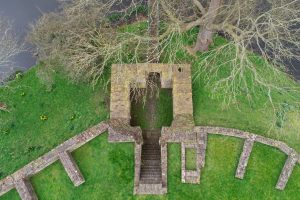
One of the most famous figures from the Bavarian dynasty is Lady Jacoba of Bavaria. Her story has been told repeatedly in various novels. After her death in 1436, her last husband, Frank van Borselen, became the owner/user of the Burcht . He often came here to practice falconry.
After his death in 1470, the lordship and Burcht fell to the Duke of Burgundy, Charles the Bold. He showed little interest in the Burcht. He died during the Battle of Nancy. Margaret of York, widow of Charles the Bold, then became the owner of the Burcht. She saw potential in the gazebo and invested heavily to make it habitable again. Unfortunately, she never enjoyed the final result, as she died in 1503. The Burcht then fell into the hands of Charles V. He continued restoring the outer bailey, in particular. Sadly, he, too, would never visit the Burcht.
In 1534, an auction took place at which large parts of the outer bailey were sold to prevent materials from being stolen to build houses and barns across the island. Bricks were expensive at the time.
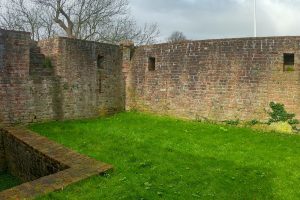 In 1552, the church tower and the keep were largely dismantled due to fears of a French invasion by sea. This effectively spelled the end for the Burcht. Afterward, the remains were demolished, covered with earth, and sold to the pilotage service to build a lighthouse. However, this lighthouse was never built.
The Burcht then fell into complete oblivion. Until 1934, as part of a work relief program, under the direction of Ir. J. Kalf (director of the National Bureau for Monument Conservation), the Burcht was excavated again. The model and drawing of the Burcht reveal his vision for its original form. The stones found during the excavations (known as monastery bricks) were stored behind the then-town hall to be reused during the restoration, which began shortly after the excavation. Because this was carried out with the help of volunteers, it wasn’t until around 1980 that the Burcht acquired its current form.
A nice detail is that on the left side of the bridge over the canal are two ash trees (Fraxinus excelsior). They have been watching over the entrance to the Burcht for over 100 years and are among the oldest in the Netherlands. You can find more information about the Burcht at the Oudheidkamer Oostvoorne.